

Strategy fails due to organizational design, and HR pays the price
HR is supposed to work strategically. At the same time, the function lacks the very foundation that makes strategic work possible in the first place: clarity about the organizational design.
The HR function is similarly organized across many companies, reflecting their operating models based on defined roles.
The key question is: How would HR work if companies designed the function from a product manager's perspective? This question has been on my mind for quite some time.
HR is now at a point where cosmetic adjustments (such as renaming it “People & Culture”) are no longer sufficient. To rethink HR's orientation, it helps to work with design criteria. This approach originates in product and service design but is equally relevant to organisational design.
Let's take this path together and define a future-fit HR function (HR 5.0) based on five design criteria.
Design criteria for HR 5.0
Design criteria describe in short sentences the characteristics that the future organization, in our case, HR, should have. They provide a clear framework and support decision-making for the appropriate organizational design.

1. Data-based decisions
HR systematically uses reliable and relevant data as the basis for data-informed decisions. Key figures, pattern analysis, and predictive (forward-looking) models support the derivation of measures, increase their effectiveness, and enable largely objective, traceable decision-making.
2. Continuous improvement (testing & iteration)
HR processes and services are continuously reviewed and optimized. Regular testing, feedback loops, and benchmarking create a learning system that identifies inefficiencies and quickly implements adjustments.
3. Radical prioritization (focus on impact)
HR works with a clear structure of goals and priorities. Strategically important topics, resources, and initiatives are identified and focused on. This ensures that decisions can be made consistently, transparently, and in a goal-oriented manner.
4. Impact measurement as the gold standard (data & value creation)
HR initiatives are evaluated based on their expected and actual benefits. KPIs, impact analyses, and regular performance reviews ensure that measures make a measurable contribution to value creation and corporate goals.
5. Stakeholder-centered service design
HR services, guidelines, and systems are consistently designed to meet the needs of the entire organization and its stakeholders. Added value, collaboration, and future viability are central to this approach.
Since every company has different HR requirements, the design criteria may vary.
What this means to HR
An HR function designed according to these criteria places new demands on:
- the operating model
- team composition
- on software and data architecture
- on the competency profile (ability to work with systems and data)
It is a fundamental rethinking of the entire HR function.
Why it makes sense to rethink HR
The classic HR operating model is outdated.
Renaming it “People & Culture“ has done little to change the way it works, and it will remain that way as long as the underlying design stays the same.
For a long time, HR was able to operate under largely stable conditions:
- sufficient availability of qualified workers
- largely stable markets
- longer strategy cycles
But that world no longer exists.
Today, we see:
- Tight labor markets and volatile candidate behavior
- Rising turnover rates
- More complex and digital business models
- Knowledge carriers leaving the company, often unexpectedly
Many HR teams are overwhelmed by these challenges and are coming under pressure.
And companies risk their business capabilities suffering as a result.
Strategic workforce planning & scenario management
It is increasingly challenging to find suitable candidates for more roles within a reasonable time frame.
That is why companies must learn to think in more extended time frames. Strategic workforce planning is a tool for securing the business and future viability of the company.
It answers questions such as:
- Which roles will disappear, change, and which new ones will emerge?
- What skills will we need and to what extent in the next 2-5 years?
- Who are our key position holders, and what risks arise if they leave the company?
- Which trends are relevant to the company, and how do they affect the composition of our personnel structure?
- What options are available to us to overcome such challenges?
The world is changing at an increasing pace. Scenario planning is an effective tool for coping with this change. It enables companies to identify the scenario they are currently facing and the measures that have already been prepared.
Scenarios enable:
- rapid assessment of the current situation
- strategic risks to be made visible
- faster responsiveness to changing conditions
Regular review and fine-tuning are necessary for strategic workforce planning and scenario management to be effective.
Organizational design as an essential input for HR
The company's organizational design determines which strategies can be pursued.
It is not the strategy that shapes the organization, but rather the organization that determines which strategic options can be pursued. Many companies are unaware of this fact, which is one of the reasons why only a small proportion of developed strategies are (or can be) implemented.
I have been observing the interface between strategy | organization | HR for years, and it will be crucial for the future of HR.
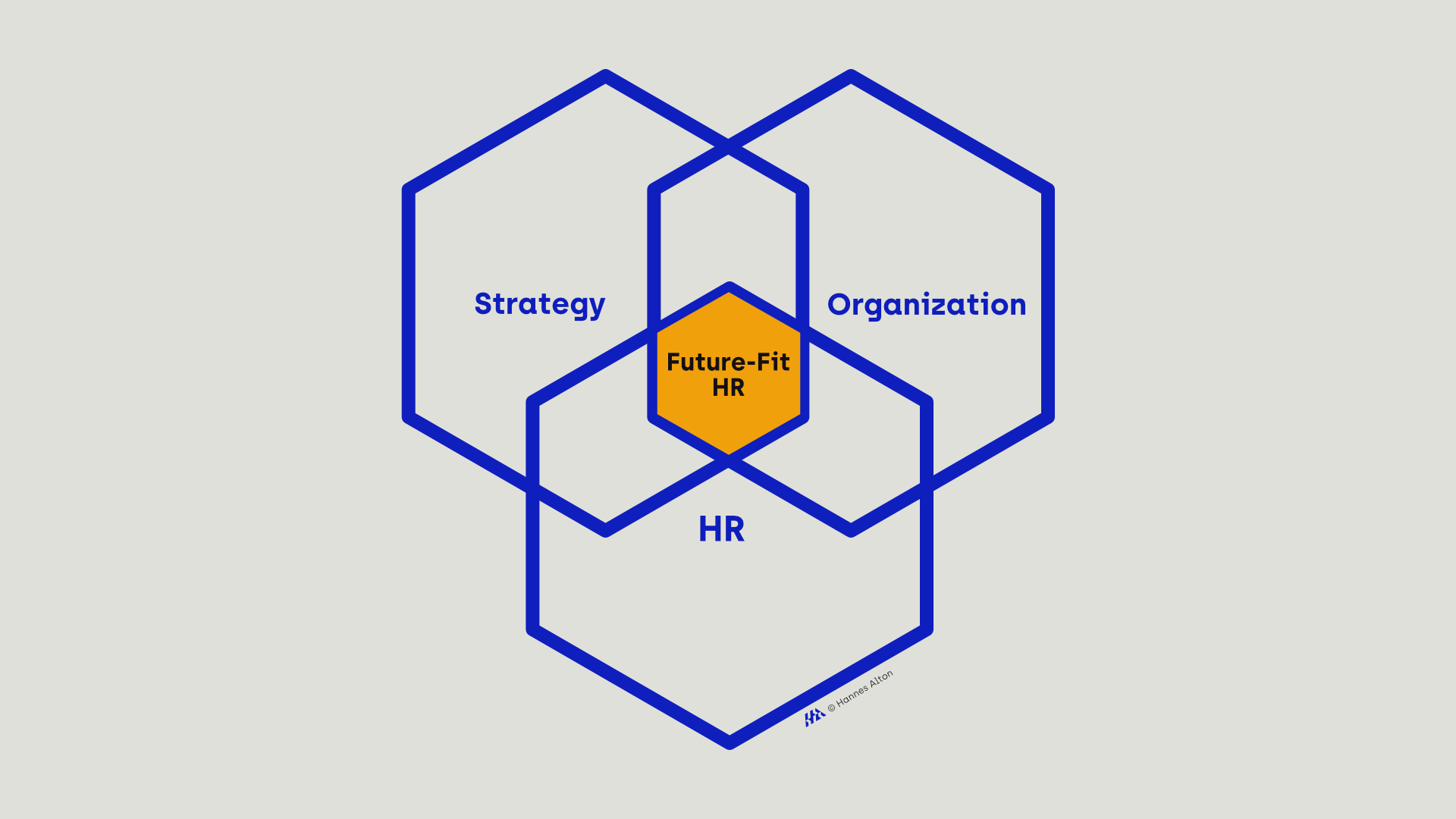
Organizational design is the approach used to define the organizational structure. Organizational design reveals which job architecture, systems, etc., are required.
These inputs are essential for HR because they enable the company to act and do business.
Without this frame of reference, there is an increased risk that HR will fail to fulfill its tasks and remain reactive.
Organizational design as a superpower of HR
Organizational design is the most underestimated key task of leadership and HR.
Organizational design deals with how systems work and interact as a whole (systems thinking). The effectiveness of the entire organization is determined by how the parts of each system interact.
HR can benefit enormously from this approach because it:
- promotes systems thinking (from reductionism to holism)
- reveals cause-and-effect relationships
- sharpens understanding of interrelationships
When HR shifts its focus away from structural (hierarchy) and procedural (processes) organization and directs its energy more toward work and the overall system, the role and perception of the entire function change.
Simply because organizational design, combined with systems thinking, creates better overall systems that benefit all internal and external stakeholders.
Every system operates based on the principles by which it was designed. A lack of fundamental knowledge about how organisations work leads to dysfunctional systems that cause many problems for companies.
HR is an interface function where many threads come together. The more familiar HR employees are with organizational design, the better HR can fulfill its tasks.
Why boundaries are important
Boundaries are important, and they provide clarity.
This clarity is lacking in many companies. Especially about the area of responsibility of HR:
- What added value does HR provide?
- Where does HR's responsibility begin and end?
- What dependencies and interfaces exist?
- Which key figures are important, and how do they relate to other company key figures?
- What tools are available to HR?
These are questions that every function (not just HR) must be able to answer.
Modularity to deal with complexity
Modularity is a proven approach to dealing with complexity.
If you start thinking about the HR function in modular terms, a completely new picture emerges. Instead of a monolithic HR department with its roles, there is a system of clearly defined modules that function like products:
- Each module (e.g., talent acquisition, learning & development, compensation & benefits) is designed as a service or product with a clear value proposition and defined customers (managers, employees).
- The services offered determine the work content, required skills, and software landscape requirements.
HR provides the necessary datasets and analyses for corporate management, thereby becoming an intelligence function. The clarity of dependencies and interfaces enables quick, focused adjustments to prevent unwanted side effects on the overall system.
Clarity and focus are more important than ever for companies, and modularity is an exciting approach to better cope with complexity and uncertainty.
Conclusion and outlook
When HR begins to work with design criteria and focuses on impact, a completely different function emerges:
- future-fit
- data-informed
- systemic thinking
- focused on value creation
Organizational design plays an essential role in this. The only question is whether HR is ready to reinvent itself from the ground up. This transformation requires not only new processes but, above all, a fundamental rethinking of the competencies and attitudes of the entire function. Some companies have already started this process.