

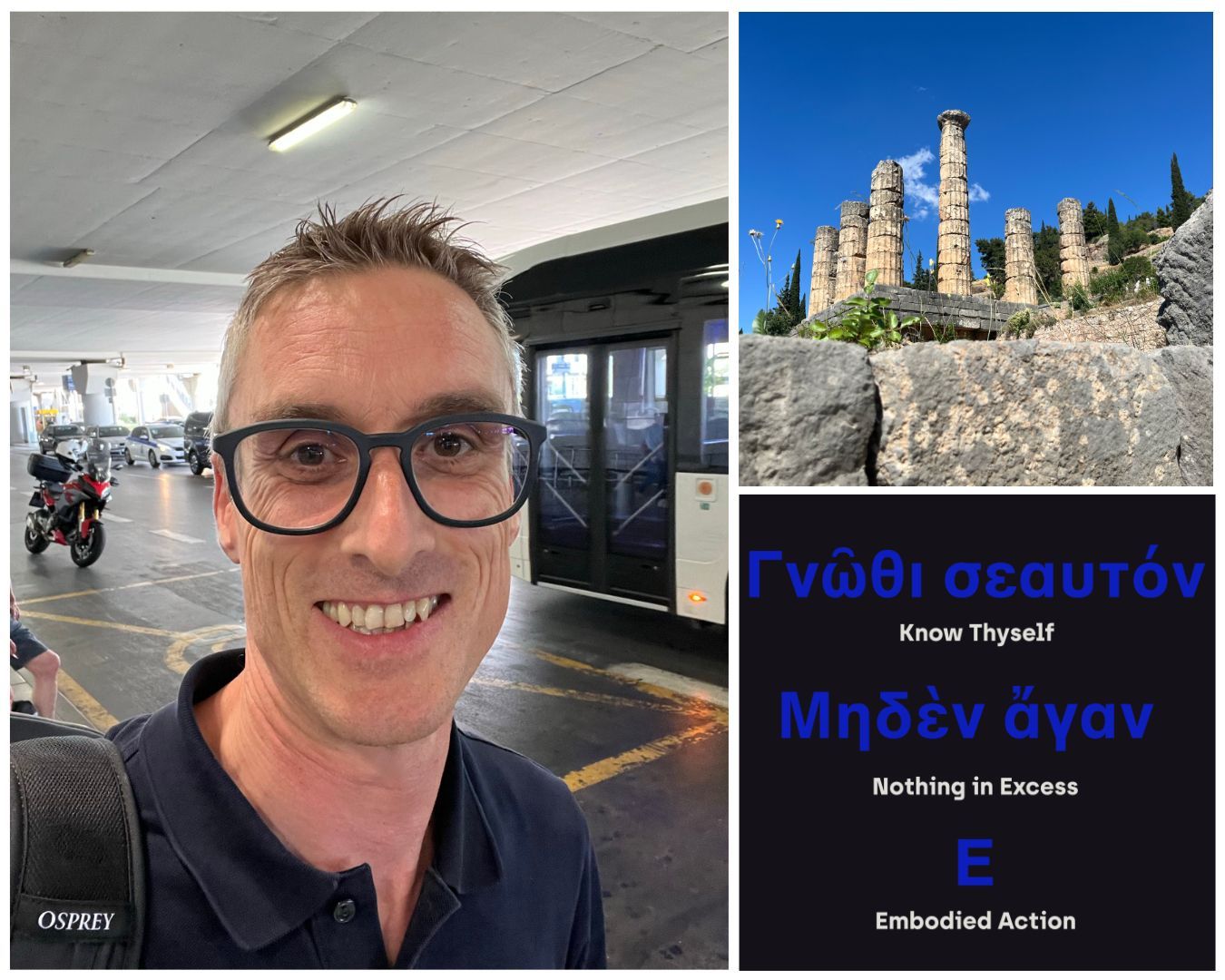
Last week I was in Delphi for a retreat. I had been invited, and when the invitation came, I felt something I could not fully explain. It was a calling, one of the kind that does not ask for reasons.
I landed in Athens energized. I knew only one person in the group, but within hours it did not feel that way.
What followed were three days of deep inner work, thought-provoking conversations and moments of unexpected lightness. People from different countries, different stories, different experiences, different backgrounds, different perspectives of seeing the world - and yet an immediate sense of connection. The kind that has the potential to redirect a life.
I am grateful for the people I shared these days with: @Anastasios Spanidis, @Loukia Papa, @Pratap Menon, Anna Maria Kalfa, Ioanna Soulkouki, @Chris Faki, @Tarek Daouk, @Michalis Boussias, @Markus Breth. Some connections carry the weight of a lifetime.
I was consciously off business. Yet three maxims, historically inscribed at Apollo's temple where the oracle was consulted, would not let me go.
Before anyone could ask about the future, three principles stood as a reminder.
Know thyself. Clarity of vision.
Nothing in excess. Balance.
Ε (Epsilon). Embodied action.
You cannot design what you have not yet understood.
You cannot act on what you have not yet balanced.
Translated into Organizational Architecture, the sequence takes shape with precision.
Know thyself means seeing the organization as it is – not as the org chart suggests, not as leadership perceives it, but as how work flows through it today. This is where every design process begins.
Nothing in excess follows from that clarity. In organizations, excess is created unconsciously over time. Too much centralization, too little decentralization. Too much bureaucracy, too little humanocracy. Too much proliferation, too little design. The answer is never to eliminate any of these – every organization needs structure and autonomy, rules and trust, hierarchy and distributed autonomy. The question is always one of proportion.
This is also why design dogma fails. Adopting any model blindly simply replaces one form of excess with another. The architecture that fits your organization emerges from knowing where it wants to go and by understanding it first.
Embodied action is what follows. Not implementation for its own sake. Movement that grows out of clarity and balance.
This sequence was understood by the ancient Greeks and inscribed in stone for anyone who came seeking answers. It contains something that some organizations are still learning.
The right architecture is not found. It is uncovered.
Where is the system carrying more than it needs to?
This insight originally appeared on LinkedIn.