

The Future as a Space of Possibility:
Why how you see the future shapes the organization you architect
We talk about the future as if there is only one.
As if it follows a straight line. As if someone today could tell you what tomorrow will look like.
They can't. And neither can you. And that gap between the certainty we pretend to have and the uncertainty we actually face is where most organizations start making the wrong decisions.
The future is not a fixed destination. It is a space of possibility, shaped by the decisions of the past and formed by the decisions we make today.
„If you want to make God laugh, tell him about your plans.“
Blaise Pascal (1623 - 1662)
This might sound abstract. But the way your organization perceives the future has a more direct impact on how it operates than most leaders realize.
The paradox of our time
We have more information available than at any point in human history. And yet - more uncertainty, not less.
More data. More noise. More competing signals. More pressure to act decisively on incomplete information.
Organizations respond to this paradox in predictable ways. They invest in forecasting tools, strategic planning processes, scenario workshops. They try to reduce uncertainty by gathering more information. What they often end up with is analysis paralysis or worse, false confidence in a single version of the future.
The problem isn't the lack of information. It's the underlying assumption: that the future can be predicted, planned for, and controlled. That if we just model it correctly, it will cooperate.
It won't.
„I know that I know nothing.“
Socrates
The future has always been a space of possibility
Here is a more useful frame: the future is not a single destination waiting to be reached. It is a space of possibility - a field of potential futures, each shaped by the decisions being made right now.
Some of those futures are more accessible than others. The boundaries of this space are defined by past decisions - structural choices, resource allocations, relationships built or neglected, capabilities developed or atrophied.
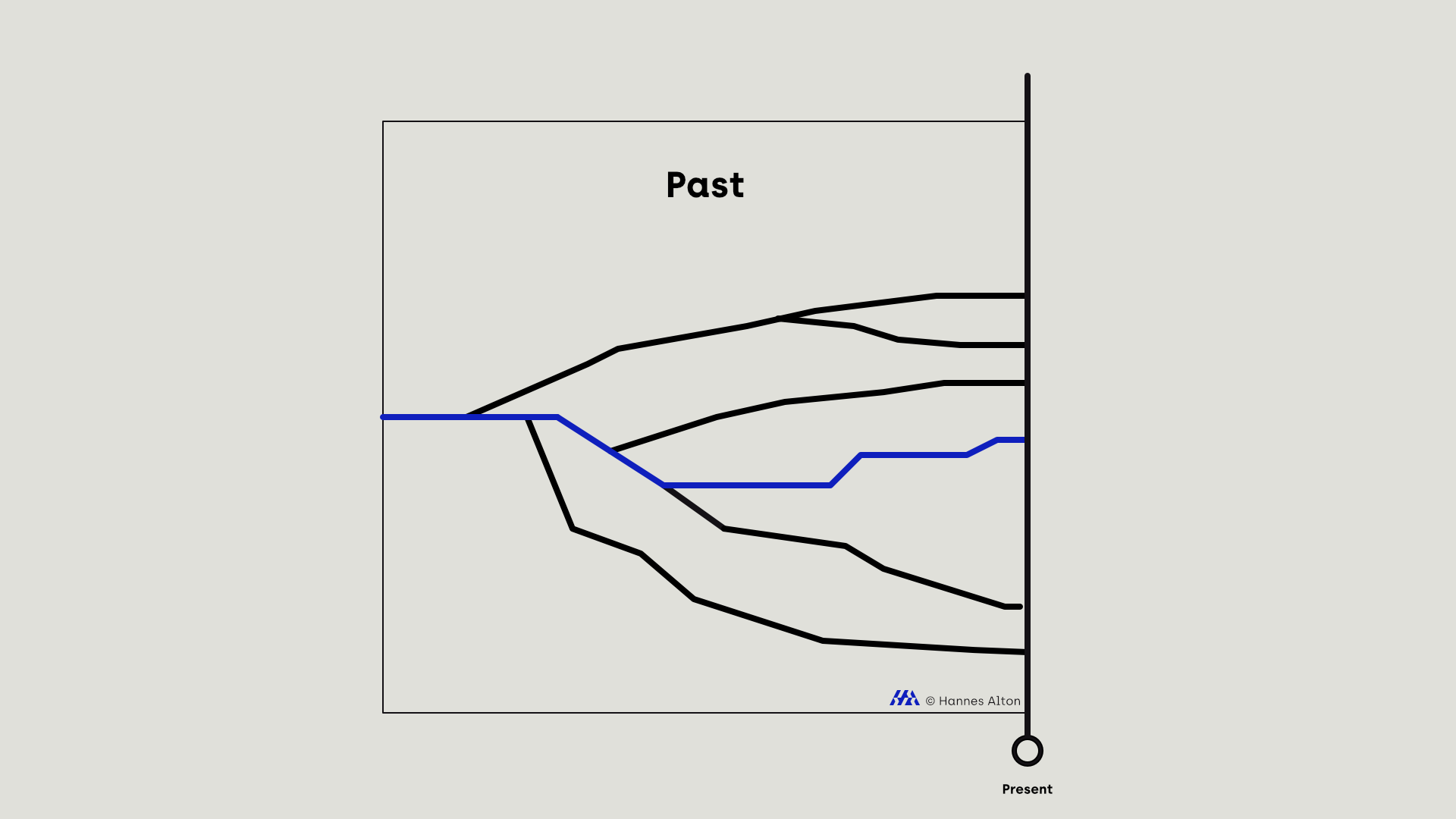
Every decision you make today either expands the space or contracts it.
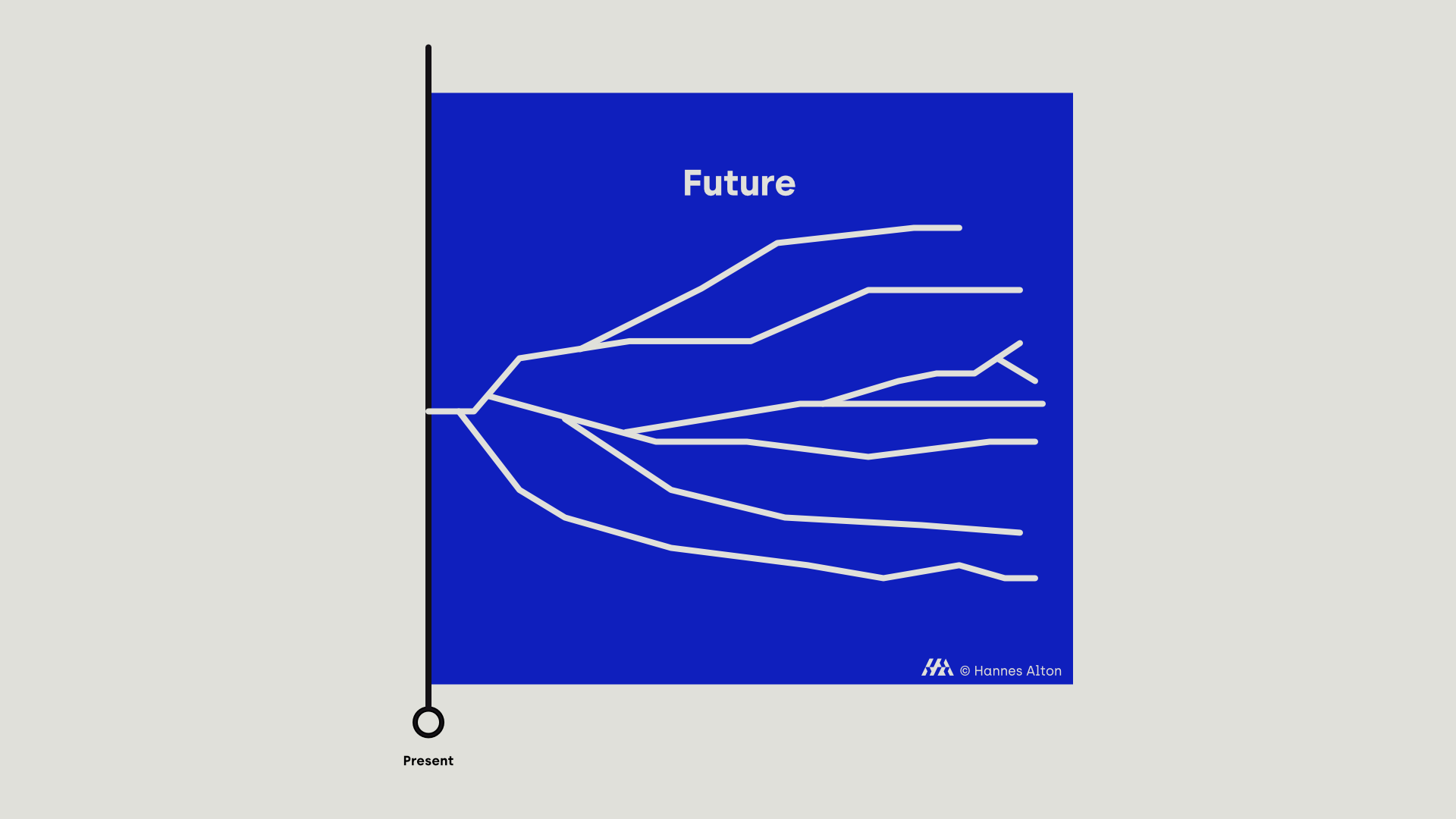
This matters enormously for organizations.
Because if the future is a space of possibility, then strategy is not about predicting which future will arrive. It is about understanding the shape of the space you are operating in - where its edges are, what is within reach, what is not - and making decisions that expand it rather than constrain it.
Organizations that understand this act differently. They are not chasing a plan. They are moving through a space they understand.
What this looks like in practice
Most organizations I work with have a strategy. A document. A direction.
What they often lack is a clear understanding of the space of possibility their organization actually occupies. The boundaries set by past structural decisions. The capabilities that open certain futures and close others. The signals from their environment that are shifting the space - often slowly, then suddenly.
When leaders treat the future as a linear projection of the present, they optimize for the wrong things. They invest in parts of the system rather than its overall capability. They respond to symptoms rather than the underlying architecture. They find themselves repeatedly surprised by changes that, in hindsight, were entirely visible.
And they tend to ask the wrong question. Not "what is the shape of the space we are operating in?" but "what is our target for next year?"
The second question is useful. The first one is essential.
The decisions that shape the space
The boundaries of your organization's space of possibility are not fixed. They are the accumulated result of every structural decision made over time - how work is organized, where decisions are made, what capabilities have been built, how information flows through the system.
Some of these decisions were deliberate. Many were not. Most organizations are, to some degree, the result of accumulated improvisation rather than intentional design.
This is neither a judgment nor a problem in itself. It is simply a starting point.
The question is: do you understand the space your organization currently occupies? And are your current decisions expanding it or contracting it?
Because the future will arrive regardless. The only choice is whether you have designed an organization capable of meeting it.
If you want to understand the shape of the space your organization currently occupies, and which decisions are expanding it or contracting it - that is a good starting point for a conversation.