

The Paper Victory: A Systemic Autopsy of Winning into Chaos
How a plant won every contract, lost on every part, and what that taught me about systems that blind themselves.
They won every project.
That sentence should sound like success. It isn't. In this case, it was the most precise description of a system that had cut the wire to reality, and then kept running, faster and faster, in the wrong direction.
This is the story of a plant I worked with from Q4 2022 into Q1 2023. A plant in Germany, part of a large multinational, embedded in a global supply chain, operating in the automotive sector. I was brought in to help solve what was described as a recruiting problem: the plant needed to extend shifts to 24/7 operations and wasn't getting the right people onboard fast enough.
Easy going, my colleague said.
It wasn't.
The Noise Was a Signal
The first thing I noticed wasn't a missing process or an understaffed team. It was noise.
Not noise in the literal sense – noise in the systemic sense. Priorities shifted daily. Sometimes hourly. The recruiting team said one thing; management said another. The HR Manager kept reassuring everyone that things were under control. The numbers were available but had to be cleaned before any analysis was possible. The onboarding was chaotic. Every Friday brought a new reporting cycle, and every Monday a new set of priorities.
When priorities shift faster than a system can respond, people stop thinking and start reacting. They lose the ability to filter information. The system loses its internal compass.
This is what the Darkness Principle looks like in practice: no system can be known completely. There is always something hidden until you find the right light switch.What I was hearing from management and what the system was actually doing were two different things. The art was in learning to read the latter.
Multitasking is often misunderstood as a personal failing. It isn't. It's a systemic symptom. When the organization cannot hold its priorities stable, individuals are forced to carry the instability themselves. The result is predictable: everything takes longer, everything arrives late, everything costs more than it should. The people weren't the problem. The system was.
The Noise Was a Signal
The first thing I noticed wasn't a missing process or an understaffed team. It was noise.
Not noise in the literal sense – noise in the systemic sense. Priorities shifted daily. Sometimes hourly. The recruiting team said one thing; management said another. The HR Manager kept reassuring everyone that things were under control. The numbers were available but had to be cleaned before any analysis was possible. The onboarding was chaotic. Every Friday brought a new reporting cycle, and every Monday a new set of priorities.
When priorities shift faster than a system can respond, people stop thinking and start reacting. They lose the ability to filter information. The system loses its internal compass.
This is what the Darkness Principle looks like in practice: no system can be known completely. There is always something hidden until you find the right light switch. What I was hearing from management and what the system was actually doing were two different things. The art was in learning to read the latter.
Multitasking is often misunderstood as a personal failing. It isn't. It's a systemic symptom. When the organization cannot hold its priorities stable, individuals are forced to carry the instability themselves. The result is predictable: everything takes longer, everything arrives late, everything costs more than it should.
The people weren't the problem. The system was.
What Was Actually Broken
To understand the recruiting problem, I had to understand why recruiting had become a problem in the first place.
The plant had been acquired a few years earlier. It had been performing well – that's why the new owner bought it. But the new owner didn't ask how it worked. They imposed their ways of working instead. Some of the people who held critical knowledge left. Productivity began to erode.
In automotive, productivity margins are thin by design. When productivity drops, quality follows. When quality drops, supply chain reliability drops. And when supply chain reliability drops, pressure returns to the people on the floor, which drops productivity further.
This is what the 1st Circular Causality Principle describes: positive feedback drives state change. Reinforcing loops amplify whatever direction the system is moving in – growth or collapse. Here, every signal was feeding the next. Productivity issues led to quality issues. Quality issues led to supply chain failures. Supply chain failures led to turnover and people pressure. People pressure led back to productivity issues.
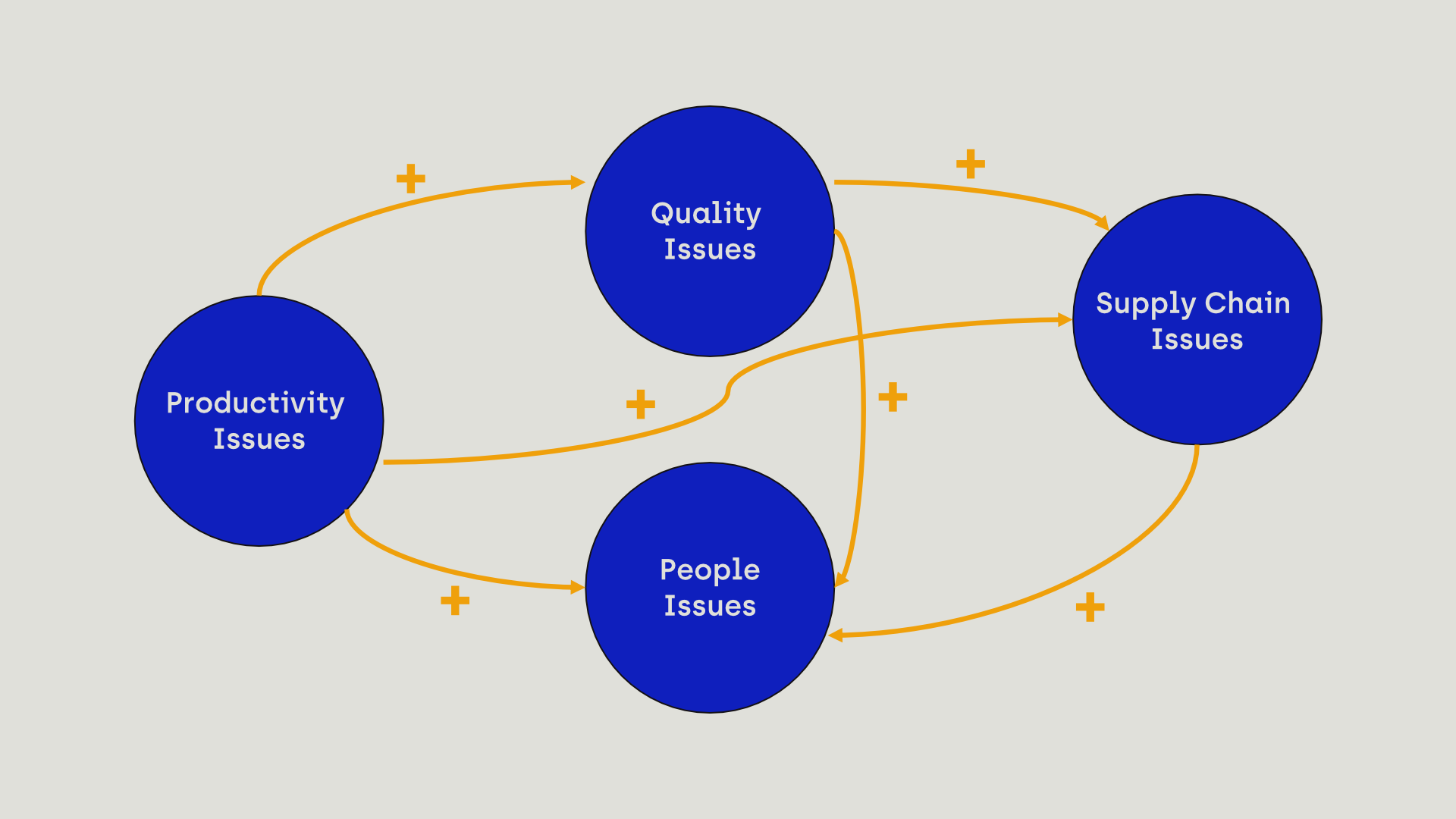
The reinforcing loop was complete. And what was missing were the balancing feedback loops – the mechanisms that would have caught the signal and corrected the trajectory before it escalated.
What they had instead: a 70% scrap rate.
Out of 100 parts produced, 70 were wrong. To avoid halting their customer's assembly line, the plant organized emergency logistics running through day and night – many times for a single part.
A system under enough pressure doesn't stop to evaluate. It responds. It moves faster. It finds workarounds. And every workaround makes the underlying dysfunction harder to see.
The Numbers That Didn't Exist
In January 2023 – roughly eight weeks before the non-negotiable February deadline – a leadership transition created a kind of reset. New people came in, and it was the moment the real numbers finally surfaced.
Shift leaders and department heads sat down and gave us their actual figures. Both the as-is data and the to-be targets had been wrong from the beginning.
This is where the Paper Victory became visible.
The plant had been working with a staffing plan that said: we need 12 new FTEs. So they set out to hire 12. But a staffing plan is only as good as the assumptions behind it. A 25% annual turnover rate meant they needed 3 more just to replace attrition. An absenteeism rate of 10% added another 1.2. Before a single shift was extended, the real target was closer to 16 - with an onboarding lag that made the February deadline structurally impossible.
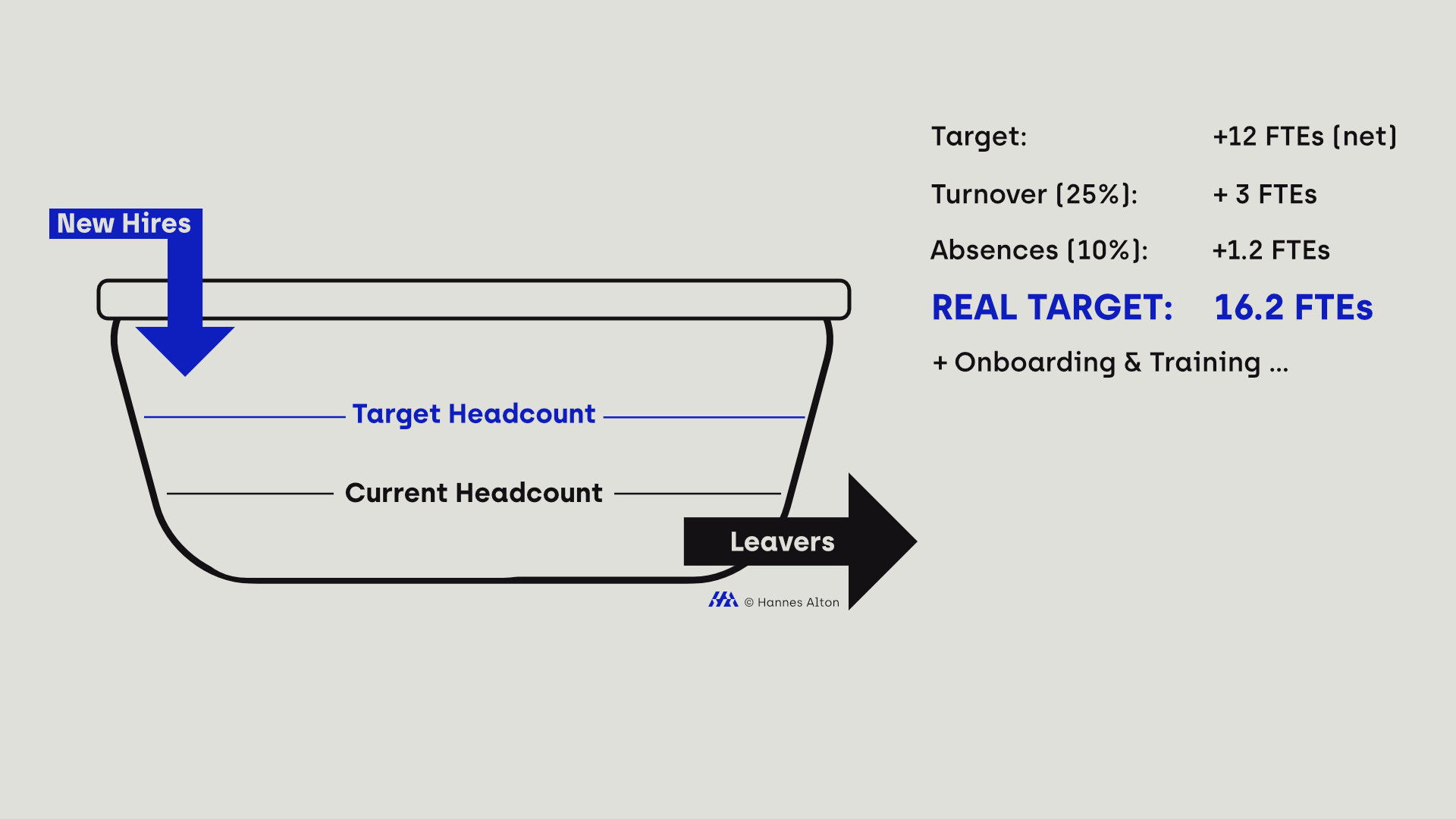
(The numbers here are illustrative – the actual figures were larger by an order of magnitude.)
Nobody said this out loud.
This is linear thinking embedded in organizational practice: we need X, so we hire X. The system doesn't work that way. Stocks and flows don't work that way. You cannot know how much water to pour into a bathtub if you don't know how fast it's draining.
But the cost structure problem ran deeper than the staffing plan. When we dug into the financials, we found that the numbers driving every pricing decision – every contract bid, every capacity calculation – didn't correspond to what it actually cost to produce a single part. The cost model was a fiction.
So the plant went to market and won contracts. Competitively priced contracts. And they lost money on every piece they produced – whether the part was right or wrong.
When the real numbers finally surfaced, the response from the top was telling: nobody challenged the numbers before.
The Dependency That Shouldn't Have Been There
There was one more dynamic I hadn't fully seen at the beginning.
The external consulting team – including me – reported directly to top management. Decisions were made at the top. Local management gradually stepped back. What looked like efficiency was quietly eroding local ownership.
Competencies that should have been built internally were being handled externally. The plant was becoming dependent on the people who were supposed to help it become independent.
It's one of the quieter ways a system gets weaker while appearing to get help. When the intervention becomes the crutch, the system never learns to walk on its own. And when the consultants leave – as they always do – the organization is left less capable than before.
Too much centralized control leads to a lack of ownership. That's not a leadership philosophy. It's a systemic mechanism. Ownership lives at the level where work actually happens. Remove it, and you remove the organization's ability to self-correct.
What the System Was Trying to Say
The **Steady State Principle** holds that a system's stability depends on the stability of its sub-systems. You cannot build a stable organization out of unstable parts.
Look at this plant in early 2023:
- The production sub-system: running on wrong numbers
- The quality sub-system: 70% scrap
- The HR sub-system: structurally misaligned from the start
- The financial sub-system: disconnected from reality
Each part was telling the same story. The system wasn't hiding its dysfunction – it was broadcasting it, in every metric, every emergency, every shift leader who couldn't answer a basic capacity question without hesitation.
What was missing wasn't data. It was the willingness to read it.
The Relaxation Time Principle adds another layer: a system repeatedly shocked at shorter intervals than its recovery time may never stabilize. This plant had been hit again before it could process the last impact. New ownership. Imposed processes. Knowledge loss. Productivity decline. Quality failure. And now: an unrealistic deadline nobody dared question.
The system was living in permanent vibration.
The Lesson Beneath the Story
The paper victory is not a story about bad management or incompetent people. It's a story about what happens when an organization loses its feedback loops.
Feedback loops are how systems learn. They're how a system knows whether it's moving toward its goal or away from it. When those loops are cut – when numbers don't reflect reality, when people don't ask questions, when external consultants absorb the decision-making that should stay inside – the system becomes blind to itself.
And a blind system keeps moving. It wins contracts. It hits short-term targets. It reports progress. Until the gap between the paper reality and the actual reality becomes too large to bridge.
The intervention that was needed here wasn't a better recruiting process. It was a serious look at the system as a whole – its structures, its feedback mechanisms, its cost logic, its ownership architecture. Work the system, not the symptoms. That work never happened. Or rather - it happened too late, under too much pressure, with a deadline that was unrealistic before the first conversation even began.
The paper victory can happen anywhere. In any industry. At any scale. It doesn't require bad intent or carelessness. It requires only this: a system that has learned to protect itself from the information it most needs to hear.
The real question is not whether it's happening somewhere in your organization. It probably is. The question is whether you've built the conditions to see it before the gap becomes too large to bridge.
Most organizations don't see the gap until it's already too large to bridge. If you want to look at your system before that happens -
let's talk.